Best Snow Chains for Cars and SUVs
As an Amazon Associate I earn from qualifying purchases. We may also earn a commission through Walmart links.
Best snow chains for cars and SUVs at a glance
Start with Peerless Auto-Trac if your owner’s manual allows its clearance class and you want a self-tightening chain. Choose Peerless Super Z6 if the vehicle has limited space behind the tire and permits cables. For a compatible SUV whose manual allows the required space, the König XG-12 Pro is the premium pick. If your manual prohibits conventional chains or cables, check the exact alternative it permits before buying.
Compare five snow chains and cables by fit
| Model | Best fit | What to verify |
|---|---|---|
| Peerless Auto-Trac | Self-tightening link chain | Class S. Check the matching SKU. |
| Peerless Super Z6 | Cable for tight inboard clearance | 6.3 mm at the inner sidewall. Verify tread clearance too. |
| König XG-12 Pro | Premium automatic-tensioning chain for compatible SUVs | Use the König fit guide and vehicle manual. |
| Peerless Radial Chain | Basic passenger cable | Check the full clearance diagram and part number. |
| Peerless Z-Chain | Diagonal cable | Class S. Compare its clearance with Super Z6. |
1. Peerless Auto-Trac — best self-tightening snow chains for most compatible vehicles
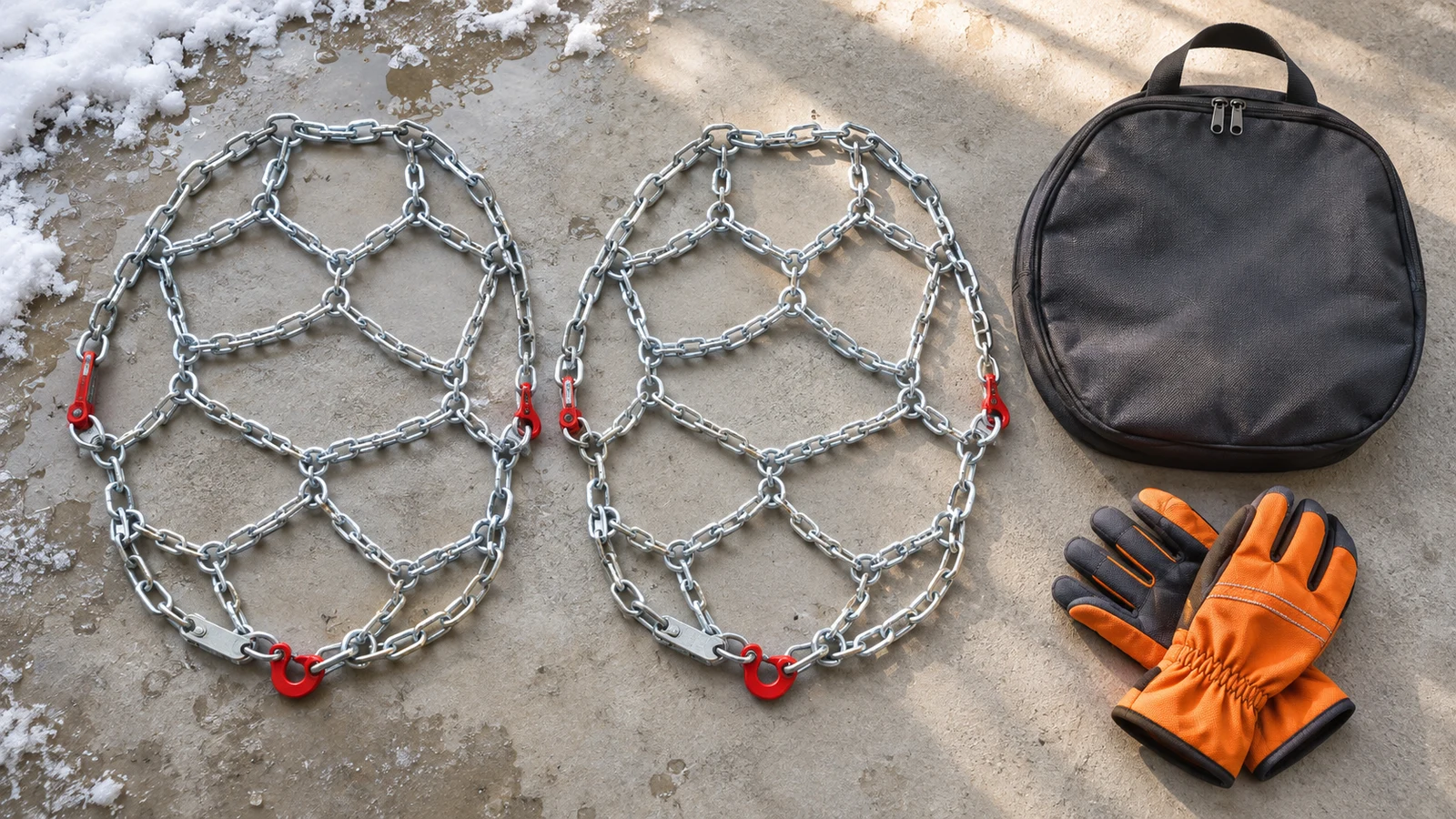
Auto-Trac uses a diamond-pattern alloy link design and ratcheting tensioners. Peerless says the system tightens itself as the wheel turns and that the chain can be installed without moving or jacking up the vehicle. The manufacturer lists Auto-Trac as a Class S product. That combination makes it a sensible first pick for drivers who expect to encounter chain controls more than once and want a link chain they can practice installing at home.
The purchase decision comes down to fit and access. You still need to reach behind the tire to connect the inner cable. When you practice, wear the gloves you expect to carry on the trip. Check whether you can reach the connection and work the outside tensioners comfortably. Match the size printed on your tire with Peerless’s application chart and confirm that the retailer’s selected variant shows the same part number. Peerless says an extra tensioner is unnecessary for this model.
2. Peerless Super Z6 — best for tight inner-sidewall clearance
Super Z6 is a diagonal cable design with built-in rubber tensioners. Peerless specifies 6.3 mm of operating space at the critical inner-sidewall area. The tread face needs its own clearance, so read the full clearance diagram and the vehicle manual before treating that number as a fit. A fender gap you can see from the outside tells you little about the room near the inboard suspension.
This is the first product to compare when the manual permits a cable device and calls for unusually limited clearance. It is also worth considering if you alternate between wheel sets. Read the sidewall on the winter tires you have actually installed and repeat the lookup after a wheel change. Super Z6 listings show multiple part numbers. A popular size in the listing photo may be a different size from the one currently selected in the cart.
3. König XG-12 Pro — premium pick for compatible SUVs
König designed the XG-12 Pro for larger SUVs, vans and similar vehicles. Its automatic tensioning system takes up slack as the wheel rotates after the initial connections are secured. Choose it when you value that mechanism for regular trips in winter conditions and the König fit guide and your vehicle manual both support the application. The price premium buys an installation and tensioning design with a specific intended use, so there is little reason to pay it if a permitted lower-cost cable meets your needs for an occasional trip.
Find the exact XG-12 Pro size from König before browsing. Retail listings can look nearly identical across several sizes. If you have larger aftermarket wheels, an oversized tire or a staggered setup, verify the actual mounted tire on the axle the manual specifies. An automatic tensioner can take up slack within the product’s intended fit range. It cannot make a wrong size or an unsuitable wheel well safe.
4. Peerless Radial Chain — a basic cable option for occasional use
Peerless describes its passenger Radial Chain as an all-steel cable design with traction coils. Consider it when you need an occasional-use cable, its chart includes your tire, and the manual allows its clearance requirements. Start by comparing the exact matching part number against Super Z6 rather than assuming all cables use the same amount of space. Peerless lists different tread-face and sidewall clearances for those products in its technical catalog.
Before ordering, open the model’s installation instructions. Check how it closes, how the manufacturer directs you to confirm its tension, and what the package includes. If you plan to carry it for a single mountain trip, practice putting it on and taking it off before departure. The simpler option makes sense when you can fit it confidently and the route allows it. Compare the full cost, including delivery, against alternatives in the same compatible size.
5. Peerless Z-Chain — diagonal cable option for regular winter routes
Peerless lists Z-Chain as a Class S diagonal cable product and describes its use by fleets. It is an option for drivers who prefer a diagonal cable and want to compare the full range of sizes available for their vehicle. Its clearance requirements differ from Super Z6, so a vehicle that permits one does not necessarily permit the other. Check the full technical chart even if both products list your tire size.
Compare Z-Chain and Auto-Trac by the closure and tensioning systems you will actually use. If you can work the Auto-Trac ratchets quickly in gloves and the car accepts a link design, start there. If your owner’s manual permits a cable and Z-Chain is available in the matching part number, compare that model’s installation guide and package contents. These recommendations draw on published fit charts and product instructions, with no hands-on driving tests performed for this guide.
How to choose the right size before you order
Read the tire sidewall on the axle that will receive the devices. A size such as 225/60R17 contains the width, aspect ratio and wheel diameter. All three must match the fit chart entry. Keep any prefix or suffix shown in the chart in mind and verify the part number against the manufacturer’s current documentation if your exact tire designation is unclear. A retailer filter for a make and model can be a starting point, but the tire sidewall and the chain maker’s fit chart are the information you need to compare.
Open the owner’s manual and find the section on snow chains or traction devices. Look for approved tire sizes, required clearance, the permitted device type and the axle on which you can install it. Some vehicles have different instructions depending on the tire size or package. For an AWD vehicle, use the manufacturer’s stated axle guidance and check the road authority’s requirements before travel. If the two cannot be satisfied together for your route, choose a different route or postpone the trip.
Finally, look up your tire size in the device maker’s chart. Copy the specific part number, check the variant in the retailer cart, then confirm the number on the package once it arrives. Verify how many devices are included and check the seller’s return window. Save the instructions offline and test-fit at home in accordance with the manual and product instructions. That last step is especially valuable if a delivery is close to your departure date or your vehicle has an unusual wheel package.
How much should you pay for a compatible set?
Compare current prices only after narrowing the list to devices your car can use. Start with the exact SKU, include shipping and tax, then compare the arrival date and return terms. A listing that is cheaper by a few dollars is poor value if it arrives after your trip or has the wrong size selected. Marketplace sellers can list different variants under the same product title. When a listing’s fit table and the chain maker’s part number disagree, resolve the mismatch before ordering.
Buy for your expected use. A compatible basic cable can make sense for an occasional winter trip. A self-tightening design is worth comparing if you expect frequent installation and removal. If parking at home lets you safely practice with either, time the whole process, including getting the devices out of the bag and putting them away. Ease of use matters most when you have cold hands and limited space around the vehicle.
Prepare for winter chain controls
Before departure, check the road authority’s live conditions for your route. Caltrans, for example, directs California drivers to QuickMap and its Highway Information Network. Controls can change as weather and road conditions shift. If chains are required on your route, follow posted instructions and pull fully off the roadway into a suitable area before installing them. Use the lower applicable speed limit from the road signs, vehicle manual and device instructions.
Pack the correctly sized devices where you can reach them without unloading the trunk. Bring winter gloves and a light, and keep the instructions somewhere you can open them without a mobile signal. If you notice striking sounds, vibration or a change in how the vehicle feels after installation, stop in a safe location and inspect the device according to its instructions. Remove the devices when road rules and the manufacturer say to do so. After the trip, follow the manufacturer’s cleaning and storage instructions before putting them away.
Winter prep also starts with your tires. Check cold pressure against your vehicle’s tire-pressure label and see our guide to choosing a pocket tire inflator if you want a compact tool for routine top-ups. Pressure checks and traction devices serve different purposes, so prepare for both before a winter trip.
Frequently asked questions
Are snow chains and snow cables the same?
Both are supplemental traction devices, but the materials and construction differ. A metal link chain uses interconnected links across the tire, while a cable device uses cable cross members with traction elements. Check the model’s full clearance requirements and verify that both your vehicle and the road authority permit that type of device.
Will one set fit every tire on an SUV?
No. Some SUVs use different tire sizes front and rear, and trims of the same model may have different clearance restrictions. Use the size printed on the actual tire, the approved installation axle and the manufacturer’s part number. If you switch wheel sets for winter, repeat that check against the new tires before packing for a trip.
Does Class S mean my car can use the chains?
Class S describes a clearance category. Your vehicle’s manual can specify a tighter limit, allow a particular type of device or prohibit certain applications. Check the inboard and tread clearances from the device maker against the vehicle manufacturer’s directions before purchasing a set.
Can AWD and snow tires replace chains on mountain roads?
It depends on the route and the active restrictions. Check the road agency’s current guidance and follow signs or directions at checkpoints. Confirm what you must carry as well as what you must install, since those requirements can differ. Use the device and installation axle your vehicle manufacturer allows.
Should I put snow chains on all four tires?
Follow the vehicle manual and local rules. Chain placement varies by drivetrain, model, tire configuration and permitted device. Look for a model-specific diagram or instruction rather than choosing an axle based on a generic rule. Check how many devices a retailer sells in a package once you know how many your setup requires.
Sources and fit charts
Peerless traction product catalog and fit chart, Auto-Trac specifications, Super Z6 specifications, Radial Chain specifications, Z-Chain specifications, König XG-12 Pro specifications, and Caltrans chain controls.