
How Often Should You Check Your Tire Pressure?
How often should you check tire pressure? Check all four tires and the spare at least once a month and before long trips. Measure when the tires are cold and use the pressure listed for your vehicle.
Check all four tires, plus the spare, once a month. Do it before you drive, or after the car has sat for at least three hours. Compare each reading with the cold PSI on the sticker inside the driver’s door, not with the number on the tire sidewall.
Tires lose air slowly, even when nothing is wrong. I’d like to show you a simple routine that takes about five minutes. You will learn when to check, what number to aim for, and what to do if a tire reads low.
How Often Should You Check Tire Pressure?
The monthly rule
The National Highway Traffic Safety Administration (NHTSA) says to check your tires at least once a month. That includes the spare.
PSI stands for pounds per square inch. It is the unit that measures the air pressure inside a tire.
Other times to check
A monthly check is the minimum. Some moments call for an extra one.
- Before a long road trip
- After hitting a pothole or a curb
- When the weather turns much hotter or colder
- When a tire looks low or the car pulls to one side
- When the TPMS warning light comes on
Checking more often than once a month is fine. A quick look every week or two can catch a slow leak early.
Why the warning light is not enough
Most newer vehicles have a tire pressure monitoring system, or TPMS. It warns you when a tire is low. But it is built to warn you when a tire is already well below the target. One source citing NHTSA puts that point at 25 percent or more below the maker’s number.
A tire can be too low for good wear and fuel economy long before the light comes on. A gauge catches that sooner.
| When to check | Why it matters | What to do |
|---|---|---|
| Once a month | Tires slowly lose air over time. | Check all four tires and the spare. |
| Before a long trip | Highway miles and a full load add stress. | Check pressure and look over each tire. |
| After a pothole or curb strike | Impacts can cause sudden air loss or damage. | Check pressure and look for bulges or cuts. |
| After a big temperature swing | Air pressure changes with the weather. | Check cold pressure and adjust if needed. |
| When the TPMS light comes on | At least one tire is low. | Check all tires as soon as you safely can. |
Find the Right PSI for Your Vehicle
Use the placard, not the sidewall
The vehicle maker sets the right pressure for your car, truck, or SUV. You can find it on the tire information placard. This is usually a sticker on the driver’s door jamb. Your owner’s manual lists it too.
Front and rear tires can have different numbers. Read the placard for each axle.
The sidewall also shows a PSI number. That is the maximum pressure the tire can hold. It is not the target for your vehicle. Never inflate to the sidewall number unless the placard says the same.
| What to check | Where to find it | What it means |
|---|---|---|
| Recommended cold PSI | Tire placard on the driver’s door jamb, or the owner’s manual | This is your target. Front and rear may differ. |
| Maximum PSI | Tire sidewall | This is the tire’s limit. It is not your target. |
| Spare tire PSI | Placard, owner’s manual, or spare tire label | A compact spare often needs a different number. |
| Current reading | Your tire pressure gauge | Compare it with the placard number. |
If the placard is missing or hard to read, check your owner’s manual. If you can’t find either, ask a qualified tire technician or a dealer for the maker’s number for your exact vehicle.
How to Check Your Tire Pressure Step by Step
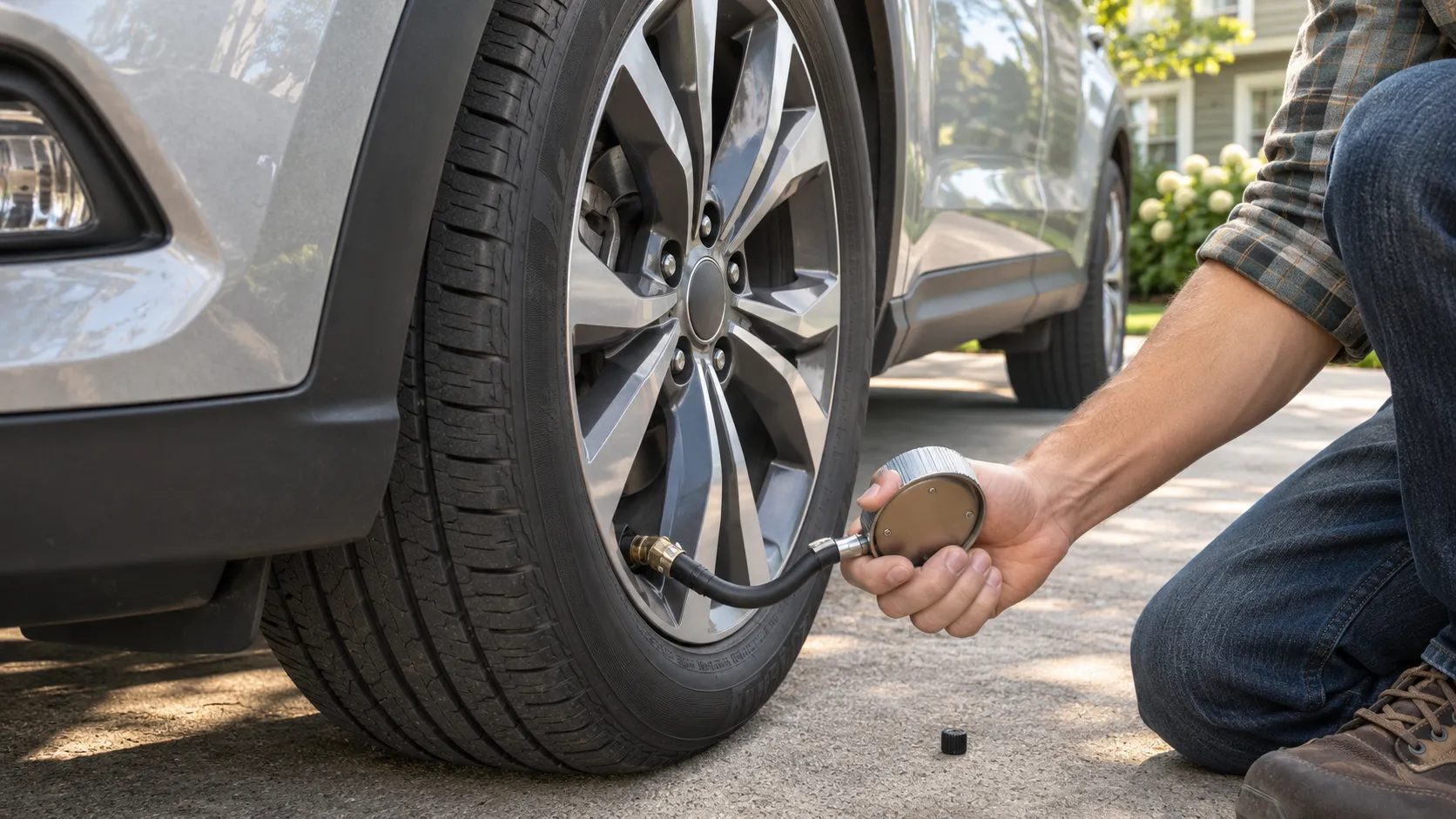
Check when the tires are cold. NHTSA defines cold as a car that has not been driven for at least three hours. Driving heats the air inside the tires and raises the reading.
Read the placard on the driver’s door jamb. Write down the front and rear numbers. Phone a photo if it helps.
Park the car and let it sit for at least three hours. Or check before the first drive of the day.
The valve stem is the small tube where you add air. Unscrew the cap and keep it somewhere safe.
Push the gauge straight onto the valve stem. You should hear a short hiss, then it should stop. Read the number.
If the reading matches, you’re done with that tire. If it’s low, add air in short bursts and check again. If it’s high, press the center pin on the valve to release a little air.
Put the valve cap back on. Repeat for the other three tires and the spare.
Keep a gauge in the glove box. Pick one date each month, such as the first Saturday, so the habit sticks.
Don’t release air from a hot tire to match the placard. The reading is higher when the tire is warm. If you must add air at a gas station after driving, add a little, then recheck the tires cold later.
What Low Pressure Can Do
Safety and tire life
Underinflated tires wear faster and can fail. NHTSA says proper pressure improves handling, tire life, and fuel economy. It also helps protect against avoidable breakdowns and crashes.
Common mistakes
- Using the sidewall PSI as the target
- Checking right after a drive
- Skipping the spare
- Waiting for the TPMS light
- Forgetting the valve cap
| Symptom | Possible cause | Next step |
|---|---|---|
| TPMS light is on | One or more tires are low. | Check all tires with a gauge and inflate to the placard PSI. |
| One tire keeps losing air | Slow leak, bad valve stem, or a puncture | Have a qualified tire technician inspect it. |
| Car pulls to one side | Uneven pressure, or an alignment problem | Check pressure first. If the pull stays, have the alignment checked. |
| Tire looks flat or squashed | Low pressure or sudden air loss | Check it right away. Don’t drive on a flat tire. |
| Bulge, cut, or cord showing | Sidewall or structural damage | Stop driving on it. Call roadside help or a tire shop. |
If a tire has a bulge, a deep cut, or exposed cords, don’t keep driving on it. Air alone won’t fix the problem. Use your spare or call roadside help, and have a qualified technician inspect it.
Check the Tire While You Check the Pressure
Include a tread check in the same routine. Our guide explains how to check tire tread depth with a penny or gauge, record the shallowest reading, and spot uneven wear.
Check the spare at its own recommended cold pressure, too. If you need to install it, check the speed and distance limits for your spare tire before you drive.
NHTSA suggests looking at tread when you check pressure. It takes a minute and fits well into the same routine.
Look for these signs:
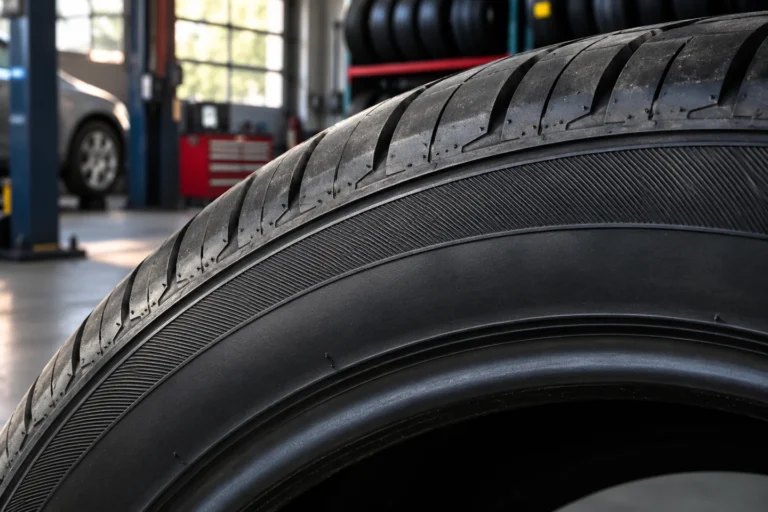
- Cuts, cracks, or bulges on the sidewall
- Objects stuck in the tread
- Uneven wear across the tire
- Raised treadwear indicators between the tread blocks
- A missing valve cap
For more detail, read NHTSA’s TireWise guidance and its tire safety page. NHTSA also offers a tire safety brochure that explains pressure, load, and tread.
Key Takeaways
- Check your tire pressure at least once a month.
- Check again before long trips and after hitting a pothole or curb.
- Use the PSI on the door placard or in the owner’s manual.
- Don’t use the sidewall number as your target.
- Check when tires are cold, meaning the car sat for at least three hours.
- Don’t rely on the TPMS light alone.
- Don’t forget the spare.
Frequently Asked Questions
How often should you check your tire pressure?
Check it at least once a month. Also check before long trips, after hitting a pothole or curb, and when the weather changes a lot.
Is it okay to check tire pressure every week?
Yes. Checking more often than once a month is fine. It can help you spot a slow leak sooner.
Do I still need to check if my car has TPMS?
Yes. TPMS is built to warn you when a tire is already well below the target. A gauge catches smaller pressure loss earlier.
What does a cold tire mean?
A cold tire is one on a car that has not been driven for at least three hours. Driving warms the air inside and raises the reading.
Where do I find the right tire pressure for my car?
Look at the tire placard on the driver’s door jamb. You can also check the owner’s manual. Front and rear tires may have different numbers.
Should I use the PSI printed on the tire sidewall?
No. The sidewall number is the maximum pressure the tire can hold. Use the vehicle maker’s recommended cold PSI from the placard or manual.
Do I need to check the spare tire too?
Yes. NHTSA says to check the spare along with the other tires. A compact spare may need a different PSI, so check the placard, manual, or spare tire label.
Conclusion
A monthly pressure check is one of the easiest ways to care for your tires. Start today. Find the placard on your driver’s door, write down the PSI, and check all four tires and the spare with a gauge. Then set a reminder for next month.

One Comment