
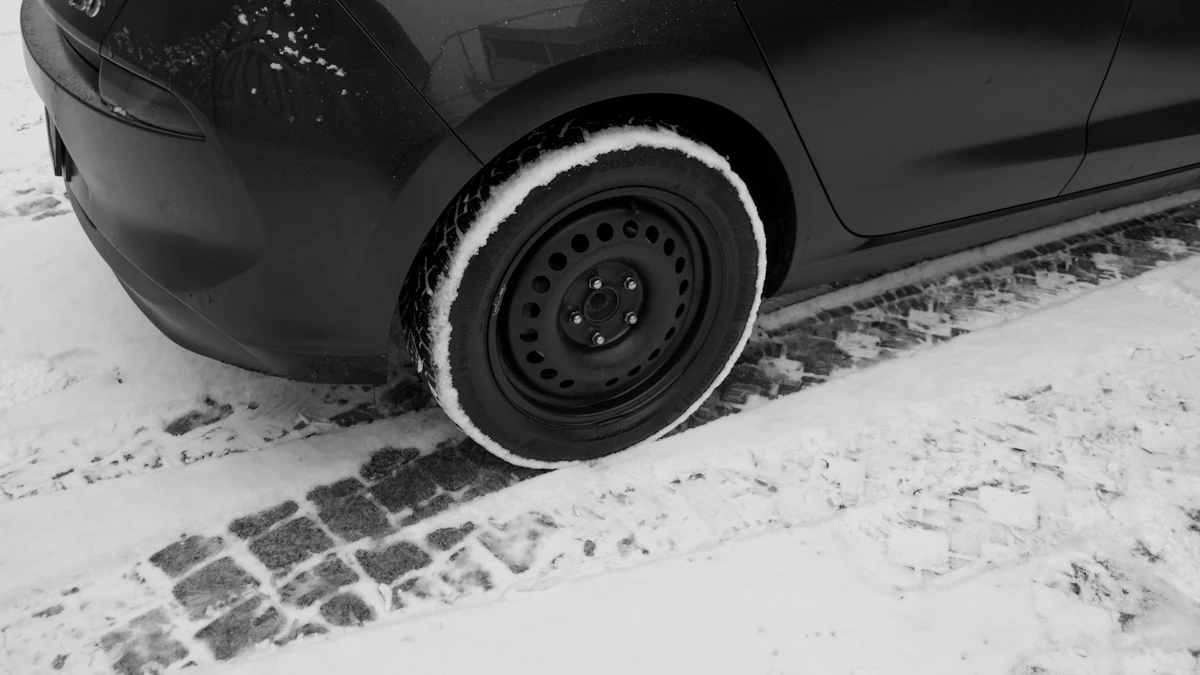
Tire Pressure in Cold Weather: What PSI Should You Use?
Use the vehicle manufacturer’s recommended cold tire pressure when the weather turns cold. Find it on the driver’s doorjamb placard or in your owner’s manual. Check each tire with a gauge before driving, after the vehicle has been parked for at least three hours. If the placard calls for different front and rear pressures, use the correct target for each axle.
Start there whether you woke up to a tire-pressure warning after a cold snap or simply want to prepare for winter. A gauge reading at each wheel helps you distinguish a seasonal pressure drop from a tire that needs inspection.
Find your PSI · Check your tires · Diagnose the TPMS light · FAQ
Where to find the right winter tire pressure
Open the driver’s door and look for the Tire and Loading Information placard on the door frame or door edge. Record the recommended front and rear pressures before you start. U.S. labels commonly show both PSI and kPa, so select the matching unit on your gauge. If the label is missing or unreadable, use the owner’s manual for your exact vehicle or ask the manufacturer for the specification.
A number printed on a tire’s sidewall refers to the tire’s limits or load rating. Your vehicle’s placard accounts for the vehicle and its intended tire fitment. For example, a door placard listing 35 PSI front and 33 PSI rear tells you to use 35 in the front tires and 33 in the rear tires when cold. Those numbers are an example. Use the numbers on your own vehicle.
Some manuals give separate guidance for a loaded vehicle or a different approved wheel and tire package. Review those instructions before a trip with passengers, cargo or a trailer. If you have aftermarket wheels or a tire size outside the vehicle’s approved options, ask a qualified tire professional to confirm the correct pressure for that setup. For a temporary spare, check the separate spare specification.
How much does tire pressure drop when it gets cold?
A commonly used estimate is about 1 PSI per 10°F drop in temperature. The exact change varies, so use that estimate to decide when to check, then take a gauge reading. A vehicle manufacturer provides this rule of thumb in a service bulletin hosted by NHTSA.
Suppose all four tires measured 35 PSI at 55°F. After a night that drops to 25°F, you might find them close to 32 PSI before driving. If your placard still calls for 35 PSI, top them back up to 35 while the tires are cold. If three tires are near 32 PSI and one is at 26 PSI, give that tire separate attention. The shared drop fits the temperature change. The extra loss on one wheel calls for a closer look.
A heated garage can mask some of the drop you’ll see after the car sits outside. If you normally park indoors but leave your vehicle outside for a work shift, take a reading before the drive home after it has been sitting for at least three hours. Follow any garage-to-outdoor adjustment guidance in your owner’s manual. A direct cold reading in the conditions where you drive is easier to interpret than an estimate.
How to check tire pressure in cold weather
Choose a level parking spot with room to move safely around the car. Bring a tire pressure gauge, an air source and a way to record your readings. A phone note works well. Set up four entries for left front, right front, left rear and right rear, then add one for the spare if your vehicle has one. Write down the target pressures and outside temperature alongside the readings.
- Start with cold tires. Measure before the first drive or after the car has been parked for at least three hours.
- Measure each wheel. Remove the valve cap, hold the gauge square to the valve stem and press firmly until you have a stable reading. If air keeps hissing around the connection, reseat the gauge and try again.
- Adjust in small amounts. Add air to a low tire in short bursts. If a cold tire is above its target, release a little air and measure again. Compare against the placard for that wheel’s position.
- Recheck with the gauge. A final independent reading is useful even when a compressor has an automatic shutoff. Reinstall the valve caps when you’re done.
- Check the spare if fitted. Use the pressure specified for that spare. It can differ substantially from the road tires, and the dashboard may never show its pressure.
When you use a gas-station pump after driving, the tires may already be warmer than they were at home. Check them before the trip whenever possible. If you suspect significant underinflation while the tires are warm, NHTSA advises adding air to at least the vehicle’s recommended cold pressure as a temporary measure. Recheck and adjust the tires once they are cold. Avoid bleeding a warm tire down to the cold target just because the warm reading is higher.
If you want to make the check at home, see our guide to choosing a pocket tire inflator. Before relying on one, confirm its power source, hose reach and run-time limits suit your vehicle. A pump that can top up a passenger-car tire may take substantially longer to add the same pressure to a larger truck tire.
What a TPMS light on a cold morning is telling you
A steady tire pressure monitoring system (TPMS) warning calls for a manual check of all four tires. Cold weather can push a borderline tire low enough to trigger the warning. The light may go out after driving because the tires warm up. Check the cold readings at the next safe opportunity even if the dashboard clears itself.
| What you notice | What to check |
|---|---|
| All four are similarly low after a cold snap | Check each wheel against its placard target, adjust cold, and record the result. |
| One tire repeatedly loses more than the others | Have that tire and wheel inspected for a leak at the tread, valve or bead. |
| Light goes out as you drive | Measure again when the tires are cold to confirm their starting pressure. |
| Light flashes, then stays on | Check pressures manually and consult the manual for a possible TPMS malfunction. |
| Tire looks flat or has a bulge or sidewall damage | Stop in a safe place and arrange assistance or inspection before continuing. |
A TPMS warning can take time to clear after inflation. Some vehicles update the display while driving under conditions specified in the owner’s manual. Others require a reset or relearn procedure. Confirm the cold pressures with a gauge first, then follow your vehicle’s instructions. If the warning persists with verified pressures, schedule a diagnosis. A flashing warning followed by a steady light generally indicates a malfunction, so keep checking the pressures manually until the system is working properly.
How to spot a slow leak after a cold snap
Use your first set of corrected cold readings as a baseline. Check again after another overnight park, ideally with a similar outside temperature and the same gauge. Look for a wheel that loses pressure faster than the others across comparable checks. A flashing dashboard light or a pressure display with dashes is a separate clue about the monitoring system and does not tell you whether that tire holds air.
A tread puncture, a leaking valve, or a bead that fails to seal against the wheel can cause a repeat loss. Tell the shop which wheel you tracked, what you filled it to and how quickly it went down. That information is especially useful when the tire looks normal by the time you arrive. If you see a nail or screw embedded in the tread, leave it in place and let the shop inspect it. If a tire is visibly flat, badly damaged or losing air quickly, arrange roadside help instead of planning another top-up and drive.
Make a winter tire-pressure routine
For U.S. drivers, NHTSA’s TireWise guidance calls for checking cold pressures at least monthly. Add a check when temperatures swing sharply, before a long trip and whenever a warning appears. When you swap to an approved winter wheel set, confirm the fitment, applicable pressures and any TPMS setup steps before relying on the dashboard readings.
You can make the routine easier by keeping a gauge where you can reach it without unpacking the trunk. A gauge with a readable display and a head that fits between your wheel spokes can be more useful than one with extra modes. If you buy an inflator, practice connecting it at home before you need it in the cold. Check the compressor’s power requirements and its instructions for how long it can run before cooling.
Pressure is one part of winter preparation. Take a look at the tread and sidewalls as you work around the vehicle. For trips into mountain areas, use our snow-chain rules guide to check restrictions by route and the chain sizing and clearance guide to check whether your vehicle can accept chains. Also see NHTSA’s winter driving checklist before you leave.
If you’re deciding between a basic compressor and a higher-capacity model, our budget vs. premium inflator comparison explains which features matter for occasional top-ups and which are worth considering for more frequent use.
Cold-weather tire pressure FAQ
Should I add extra PSI just because it is winter? Adjust each cold tire to the specification for your vehicle, tire fitment and load. A temperature-drop estimate helps predict when a check is due. Use the gauge and placard to decide how much air to add.
Is 32 PSI too low when it’s cold? It depends on the placard. A tire reading 32 PSI is on target if that wheel’s cold specification is 32 PSI. If the target is 35 PSI, add air until the gauge reads 35 while the tire is cold.
Should I check tires in the morning or after driving? Before the first drive is usually easiest. A later check also works if the vehicle has been parked for at least three hours. Record the ambient temperature if you’re comparing readings across different days.
Do winter tires need a different pressure? Check the manufacturer’s instructions for your approved winter fitment and load. If you switch size or use an aftermarket setup, confirm the correct specification with the manufacturer or a qualified tire professional.
Can I rely on the dashboard alone? Use the TPMS alert and display as cues to check. A handheld gauge lets you verify each wheel while parked, including a spare that your system may never monitor.
Featured photo by Noe Fornells on Unsplash.