How to Choose Snow Chains: Sizing, Types and Wheel-Well Clearance
As an Amazon Associate I earn from qualifying purchases. We may also earn a commission through Walmart links.
To choose snow chains, start with your vehicle owner’s manual, read the size on the tires currently mounted, and match that exact size to the traction-device manufacturer’s part number. The manual tells you the permitted device type and axle. The fit chart tells you which part number fits the tire. You need both before you order.
If you want a shortlist after checking fit, see our best snow chains for cars and SUVs. This guide walks through what to check on the car, what to compare on the package, and when a low-profile cable makes more sense than a bulkier link chain.
Snow chain buying checklist
- Look up snow chains or traction devices in the owner’s manual for your model year and trim.
- Note the permitted tire sizes, axle, device type and clearance requirement.
- Read the complete size off each tire on the specified axle.
- Find your exact size in the chain maker’s fit chart and write down the part number.
- Check the retailer’s selected size, the package contents, and the return policy.
- Practice fitting the device at home according to the chain maker’s directions.
Shopping for a low-clearance option? Check the Super Z6 fit chart first if your manual permits a cable-type device. Check Super Z6 sizes on Amazon
1. Find the vehicle’s chain restrictions
Open the manual and search for “tire chains,” “snow chains,” or “traction devices.” Read footnotes for wheel diameter, tire size, and trim. A restriction written for a larger factory wheel package may sit in the same paragraph as permission for a smaller one. If your car has aftermarket wheels or tires and the manual does not cover that combination, contact the vehicle manufacturer or a qualified tire shop before purchasing.
Write down the axle before you shop. All-wheel drive alone gives you no reliable answer about where to fit chains. Some vehicles specify just one axle. The installation instructions belong to the vehicle and traction device together. If their requirements conflict, pick a compatible device or change your travel plans when chain controls require one.
Save the relevant pages offline. A screenshot of the exact manual section and the fit-chart entry is more useful at a cold roadside than an order confirmation that says only “universal.” Keep the printed chain instructions with the kit so that anyone who drives the vehicle can identify the right pair.
2. Read the actual tire size
Look for a marking such as 225/65R17 on the sidewall. Here, 225 is the nominal section width in millimeters, 65 is the aspect ratio, and 17 is the wheel diameter in inches. The entire size matters. A chain sized for another 17-inch tire can have the wrong circumference or width even when it fits the same rim diameter.
Copy any prefix or suffix that the manufacturer’s chart distinguishes, such as LT. Verify the mounted tires on the axle named in the manual. A door placard is useful for identifying the original configuration, but your current winter set may be different. If the vehicle uses different front and rear sizes, note those separately instead of assuming one listing matches both.
Then search the manufacturer’s chart by your written size, cross-check the part number, and compare that number with the retailer’s selected variant. Retail sites sometimes combine many sizes on one listing or change the selected variant when you switch sellers. Confirm the exact SKU once more in your cart before checkout.
3. Check clearance behind the tire
Wheel-well clearance matters on the tread side and the inner sidewall. Suspension components, brake hoses, and wheel-arch liners can sit much closer to the tire than they appear from outside. Steering and suspension travel also change the available space. A quick look at a stationary wheel cannot establish which device your car permits.
If the manual specifies an SAE clearance class, maximum projection, or a cable-only restriction, compare that requirement with the exact product’s fit documentation. A phrase such as “low profile” on a listing is too vague to settle the question. Peerless publishes product-specific clearance information and a tire application guide. Use those specifications alongside the vehicle manual.
When the manual prohibits conventional chains on your tire configuration, look for the alternative it actually allows. A low-profile cable, textile traction device, or external-mount system can be worth researching when the manufacturer permits it and the route accepts it. A device that satisfies one requirement can still fail the other, so check the road authority’s current conditions before departure.
4. Compare cable, diamond and ladder designs
| Design | When to shortlist it | What to check |
|---|---|---|
| Low-profile cable | Your vehicle allows cables and inner clearance is limited. | Exact part number, clearance spec and route acceptance. |
| Diamond-pattern chain | Link chains are allowed and you want cross-links distributed across the tread. | Link thickness, inner fastening and tensioning method. |
| Ladder-pattern chain | The manual permits a traditional link chain and you want a simple cross-chain layout. | Inner clearance, tensioning instructions and vehicle application. |
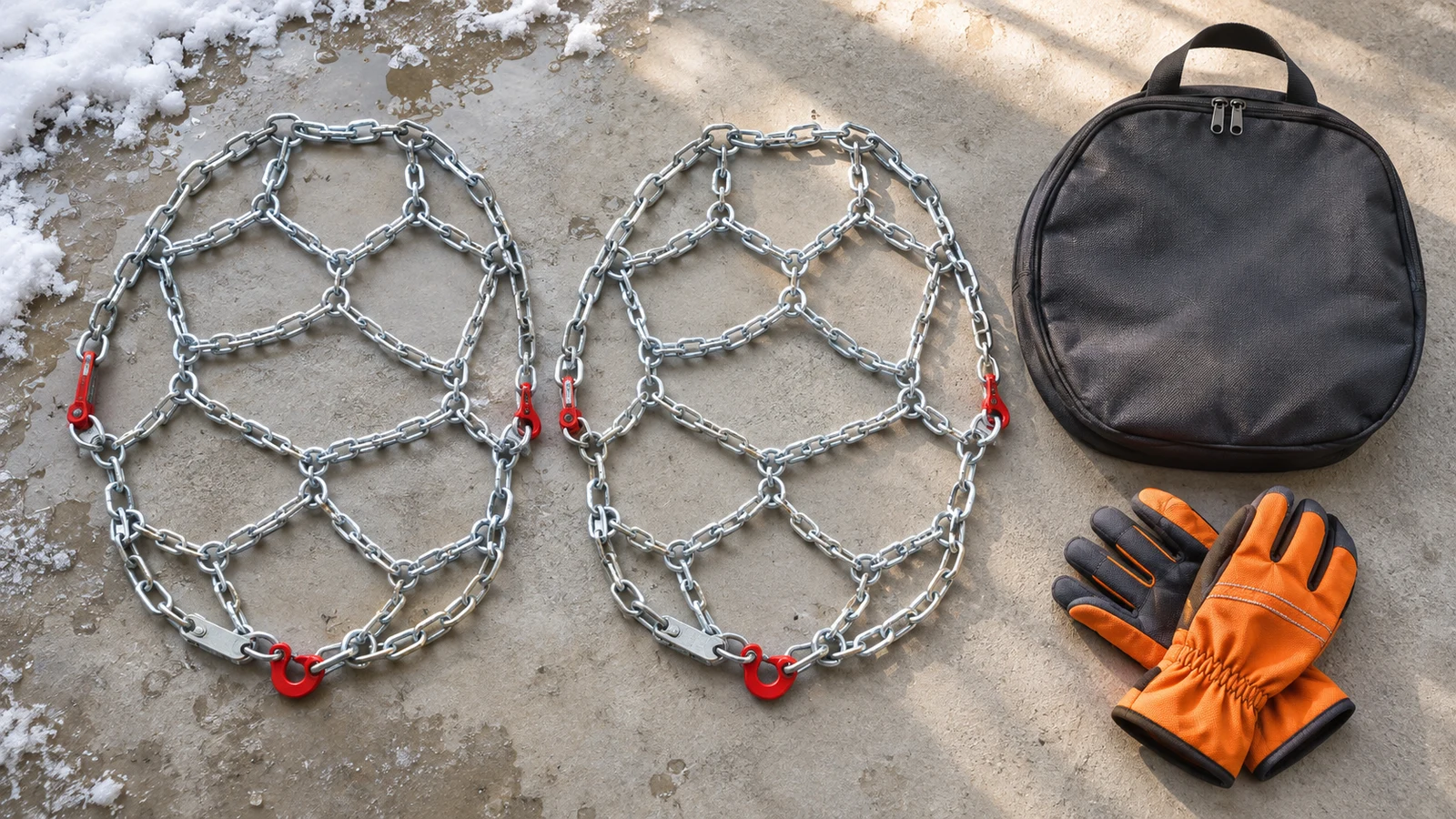
Pattern is only one part of the purchase. Look at the install sequence and ask whether you can reach the inner connection comfortably on your vehicle. Watch the instructions for the exact model with gloves on during a dry run. An easy-to-reach fastener and clear tensioning procedure can matter more to an occasional driver than a pattern name on a product page.
Self-tensioning can reduce the work involved in adjusting a compatible chain. It does not make the chain fit additional tire sizes or remove any pre-fit or inspection steps in the instructions. Compare how the selected device is secured, how it is removed, and whether spare parts and instructions remain easy to find.
Two traction devices to compare after confirming fit
Peerless Super Z6 for a cable-compatible, tight-clearance setup
Start here when the manual allows a cable-style device and you need to prioritize inner clearance. Locate your exact tire size in the Peerless application guide, note the Super Z6 part number, and confirm the clearance specification for that application. If the chart does not list your size, choose another supported option. This is a fit-based recommendation drawn from published specifications.
Compare Super Z6 listings on Amazon
Peerless Auto-Trac for vehicles that allow its link-chain design
Auto-Trac is the other shortlist option when the vehicle supports the required clearance and you want built-in tensioning. Find your tire size in the Auto-Trac column of the fit chart. Peerless may list different part numbers for sizes that look close on paper. Check both the listing variant and the product box against the match before your first trip.
Compare Auto-Trac sizes on Amazon
What to check before paying
Confirm how many devices are in the box and whether the package includes the required tensioning hardware. Check the listing photos against the manufacturer’s part number and read the fit chart rather than relying on a vehicle selector. If a seller offers several similarly named models, check who fulfills the item and whether the seller accepts a return after a clean indoor test fit.
Compare total cost across listings, including shipping and any compatible accessories the manual requires. A higher-priced model can be worth considering if its fastening system is easier for you to operate on your vehicle. If the lower-cost product already meets the fit and clearance restrictions and you can install it confidently, spend the difference on the rest of your winter kit instead.
Ordering near a storm adds pressure to substitute a near match when the correct SKU is out of stock. Resist that shortcut. Search using the exact part number first, then look up another model in the manufacturer’s fit chart if necessary. If pickup is available, confirm that the store has the specific variant before driving there.
A worked example for a crossover
Suppose your crossover currently wears 225/65R17 winter tires and you find two listings marked “fits 17-inch wheels.” Start by recording the manual’s permitted device and axle for that mounted size. If the manual calls for a cable, remove link-chain listings from your shortlist. Look up 225/65R17 in the cable maker’s chart and compare its part number against the product variant. If the chart gives a footnote, read it before adding the cable to your cart. Ask the seller for the exact part number if the retail page only shows a generic size label.
Keep a copy of the chart entry after you order. When the box arrives, check the label against that entry and test-fit the pair. If the instructions cover multiple models, find the section that applies to your part number. That record becomes especially valuable when you buy replacement winter tires, borrow a different vehicle, or move the kit into a second car. In each case, verify fit again before counting on the same equipment.
Practice before the trip
Unpack the kit in a safe, level spot off the road and follow the instructions for your exact model. Look for the inside and outside markings, identify the correct axle, and verify that the connections close correctly. Do your first practice in daylight. If the chain will not seat as instructed or appears to contact a nearby component, stop and have the fit checked before relying on it.
Keep gloves, a light and the instructions with the kit. Learn the manufacturer’s procedure for inspection after installation and its maximum operating speed. Follow posted restrictions and both manuals. If you hear a repeated strike, feel unusual vibration, or see a loose chain, pull over somewhere safe and inspect it. Remove the devices when conditions and posted controls allow according to the manufacturer’s instructions.
Snow chain sizing FAQs
Can I reuse chains from my old car?
Yes, if the old device is in serviceable condition, its exact part number is listed for the new tire size, and the new vehicle permits that device on the specified axle. Check the links, cables, and fasteners for wear. A match on wheel diameter alone gives you too little information.
Can I use chains with winter tires?
Check the requirements for the route and your vehicle. Winter tires can affect what a road authority requires in some conditions. They do not resolve a wheel-well clearance restriction. Check which types of devices are permitted before you buy and check current road controls before you leave.
Where can I confirm the size and local requirements?
For the products above, use the Peerless traction catalogue and fit chart. If you drive in California, see the Caltrans chain requirements guide and check current route conditions separately. Other states and provinces publish their own instructions.
Ready to buy? Use your manual’s permitted device type to narrow the list. Then compare the exact SKU against our snow chain roundup and double-check the selected size before checkout.

3 Comments