
Best Snow Chains for Light Trucks and Pickups
As an Amazon Associate I earn from qualifying purchases. We may also earn a commission through Walmart links.
The best snow chains for light trucks and pickups are the ones your owner’s manual permits on the tires you actually run. For a pickup that allows cables and has limited clearance, start with Peerless Super Z8. If compatible link chains are allowed and you want built-in tensioning, compare Peerless Auto-Trac. For a truck that can accommodate a traditional ladder link chain, check the truck-specific Peerless Quik Grip fit chart.
Those are three different starting points. A model that fits one wheel package on a pickup may be prohibited on another. Before buying, record the exact tire code from the sidewall, the permitted axle, the permitted device construction and the clearance restriction in the vehicle manual. Then look up the specific chain part number in the manufacturer’s chart.
Best snow chains for light trucks and pickups compared
These choices are based on the manufacturer’s published applications and design specifications. Use the chart to shortlist a model family, then enter your complete tire size to find a specific part number. For more options across vehicle classes, see our snow chains for cars and SUVs roundup.
| Model family | Best fit for | Check before ordering |
|---|---|---|
| Peerless Super Z8 | Some light trucks that permit cable-style traction devices and have limited clearance | Vehicle permission, exact part number and clearance specs |
| Peerless Auto-Trac | Compatible pickups that allow diamond-pattern link chains with integrated tensioning | Exact application, inner clearance and wheel package restrictions |
| Peerless Quik Grip light-truck series | Compatible pickups that allow traditional ladder-style link chains | Exact truck series, link dimensions and required tensioning equipment |
Peerless Super Z8 for pickups with limited clearance
Begin here if the owner’s manual allows a cable device on the mounted size and you are working with limited space around the tire. Peerless lists Super Z8 among its cable-style traction products. The family name does not identify the size you need. Find your sidewall code in the application chart and verify the specific part number and its clearance requirement before you open a retailer’s listing.
The chief reason to consider this family is clearance. A cable-style device still has hardware on and around the tire. Compare the manufacturer’s requirements with the vehicle instructions for the exact wheel package. If the manual restricts all devices for that setup, check which alternate wheel or tire configuration, if any, the automaker identifies. A low-clearance claim on the product page does not override the manual.
Compare Super Z8 sizes on Amazon
Peerless Auto-Trac for a compatible self-tensioning link chain
Auto-Trac uses a diamond-pattern link layout and integrated tensioning. Consider it when your manual permits the model’s construction and clearance requirements and the maker lists your tire size. If your goal is easier setup, read the instructions for the exact variant before deciding. Where you reach behind the tire, how the connectors close and how you inspect the setup after fitting can matter more than the marketing label.
When you compare options, look at the amount of unobstructed room around the inner sidewall on the approved axle. Also verify the wheel configuration in the vehicle manual. Sidewall clearance can matter even on a truck with a big-looking fender opening. Keep the fitting instructions with the kit and practice the complete fit and removal before a trip.
Compare Auto-Trac part numbers on Amazon
Peerless Quik Grip light-truck series for a traditional ladder link chain
Check Quik Grip if your pickup has a documented fit for a conventional ladder-style link chain. Its cross links run across the tread between the side assemblies. The Quik Grip name appears on more than one construction and application in the catalogue. Verify that the retailer is selling the light-truck series and exact part number you selected, rather than assuming that all boxes with the family name use the same hardware.
Compare package contents before comparing checkout totals. The relevant question is whether you have everything the manufacturer specifies for that model. If the installation guide calls for a particular tensioner or other accessory, confirm that it is included or available separately. A second listing at a higher price may include different equipment or cover a different tire size.
Find Quik Grip light-truck listings
How to check snow-chain fit on a pickup
- Pull up the correct manual. Look up the model year, drivetrain and wheel package. Note any permitted or excluded sizes and the stated axle.
- Read the mounted tire. Copy the full code on the approved axle. A code like LT275/65R18 contains more information than the wheel diameter alone.
- Check both sources. The vehicle manual describes permission and limitations. The chain maker’s chart gives a part number for an application. Read the footnotes in both.
- Verify the cart. Compare the exact listing variant, box contents and return conditions against your notes.
- Practice with that kit. Use the device instructions to check fit and practice fitting and removal in a safe area before the trip.
Pickup trims can use different wheels and tires. A single model name can cover several wheel packages and both two- and four-wheel-drive configurations. A retailer’s vehicle selector can help you search, but check the trim and actual tires yourself. If you changed wheels, offsets or tires, confirm the changed configuration with the vehicle or chain manufacturer before relying on the stock chart.
Get help with sizing in our guide to choosing snow chains by tire size and clearance. If you are comparing the layout of a link chain with a cable product, the cable vs. diamond vs. ladder comparison explains how construction and pattern affect the buying decision.
A worked example for a pickup with LT tires
Suppose the sidewall reads LT275/65R18 and the owner’s manual allows a suitable traction device only on the rear axle for your configuration. Note both details. Look up the complete LT code in the device manufacturer’s chart and read the column for the exact model family under consideration. If two retailer listings show the same tire size but different part numbers, compare those numbers with the chart and contact the retailer if the listing is ambiguous.
Now suppose the manual allows only a cable device for that wheel package. A diamond or ladder link chain drops off the shortlist even if its fit chart includes that tire. If the manual allows either construction, compare the allowed products for fastening, tensioning and what is supplied. If one application includes a chart footnote about the fit or requires a separate accessory, account for that before paying.
The same process helps if you borrow a chain kit. Find its label and instructions before using it. Identical rim diameters on two pickups leave room for different tire widths, profiles and available clearance. A used kit with a missing part number or questionable condition is hard to assess reliably. Use the verified fit chart and the manufacturer’s inspection instructions before deciding whether to pack it.
Match the purchase to the trip
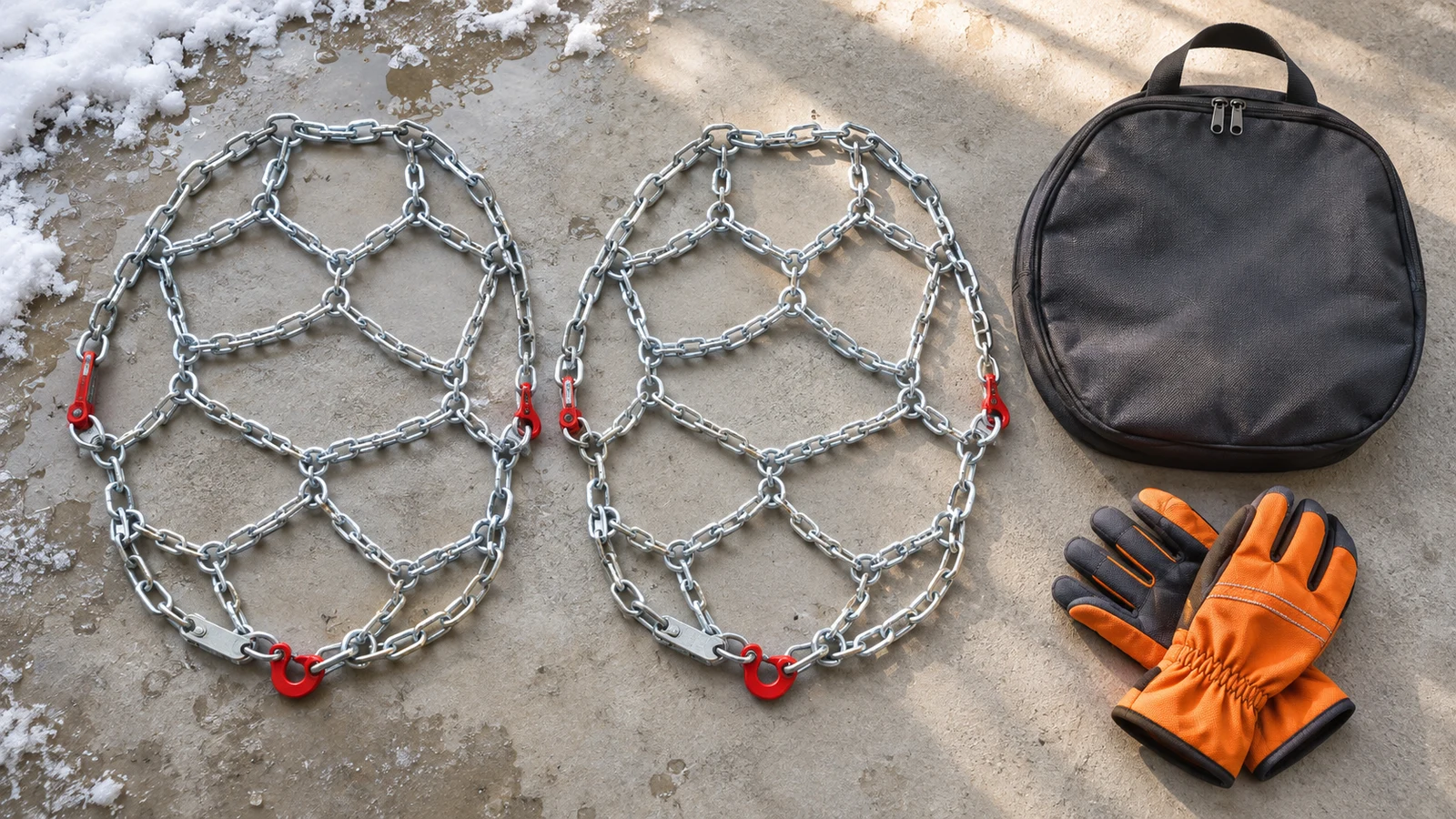
For occasional trips on paved routes, find out what the road authority accepts before shopping. Check both the current route conditions and the exact type of device the vehicle allows. Keep the hardware together where you can reach it when the bed is loaded. Practice with the gloves and light you will carry, since recognizing fasteners and reading the instructions are part of a successful roadside setup.
If you drive on unplowed access roads, think through the whole trip before comparing products. Ask where you can stop safely if you need to check or remove the equipment, and whether you can reach the kit without unloading the bed. A higher-priced model can make sense when two options both fit and one has a fastening sequence you find easier to practice. Price and appearance alone cannot establish traction performance for your vehicle or route.
Plan for removal, too. Save the instructions offline and look for designated pull-offs along a route with chain controls. Follow the road crew and posted directions in the area. If you need a refresher before testing the kit, read our guide to installing and removing snow chains, then follow the model-specific instructions for the device in your truck.
How to compare the real cost of two compatible kits
Start with the exact size selected on each listing. Record the price for the complete setup you would take on the trip, including any tensioning equipment that the device manufacturer specifies and that the listing sells separately. Check the returns policy for a clean practice fit. A price comparison made from the default size on a page can change as soon as the retailer selects the part number for your truck.
Then read the fitting instructions side by side. Pay attention to the inner connector, where the tensioner attaches, and what you need to inspect before continuing. Download a copy for the exact kit you choose and store it with the chains. If more than one person drives the truck, have each person practice with the instructions before winter travel. When both kits meet the truck and route requirements, those practical differences help you decide which one is worth paying for. Check whether you can source the required accessories before relying on a kit for a trip.
Light-truck snow chain FAQs
Which axle should I chain on a 4WD pickup?
Use the axle identified in the owner’s manual for the exact wheel and tire configuration. The same model name can cover more than one set of limits. Check any exceptions before purchasing or installing a kit. Road authorities can also apply rules about chain placement, so check the route separately.
Can I use passenger-car chains on a light truck?
Check the specific device’s manufacturer application, its part number and the vehicle manual. A generic passenger listing or the same advertised wheel diameter does not establish that the product is intended for your pickup and mounted tire. On the retailer page, read the application and model number before you choose a size.
Do I need chains if I already use winter tires?
Check the current road rules before traveling and carry the approved equipment where required. The equipment your vehicle can physically use is a separate question from what the route requires. For California routes, see Caltrans chain-control guidance and follow posted signs and official instructions.
How should I compare the final two kits?
Check the part number against the tire, then compare the fitting guide, included hardware and cost of any required accessories. If the fit is confirmed for both, prioritize the kit you can practice fitting and removing confidently. For specifications and the part-number lookup, see the Peerless traction catalogue.