
Cable vs Diamond vs Ladder Snow Chains: Which Pattern Fits Your Driving?
As an Amazon Associate I earn from qualifying purchases. We may also earn a commission through Walmart links.
Choose a cable-style traction device if your vehicle manual permits cables and your available clearance is limited. Choose a diamond-pattern link chain if your vehicle permits link chains and you want angled cross-links distributed across the tread. Choose a ladder-pattern link chain if your vehicle permits that model and you prefer a conventional layout. The correct choice depends on your tire size, approved axle and clearance requirements.
Start with our snow chain sizing and clearance guide if you have not yet checked your owner’s manual. This comparison assumes you still need to choose among products that fit. It covers what each design looks like, what the labels on the box leave out, and how to narrow a shortlist without buying the wrong size.
Cable vs. diamond vs. ladder snow chains at a glance
| Design | Choose it when | Check before ordering |
|---|---|---|
| Low-profile cable | Your manual permits cable-style devices and gives you little room around the tire. | Product-specific clearance, axle instructions and local acceptance. |
| Diamond-pattern link chain | Link chains are permitted and you want angled cross-links across the tread. | Inside fastener, specific clearance requirement and tensioning steps. |
| Ladder-pattern link chain | Your vehicle accepts a conventional link chain and the chart lists your tire and vehicle application. | Cross-link thickness, tensioning hardware and fit-chart footnotes. |
These labels describe different things. Cable identifies the construction of the traction device. Diamond and ladder describe how cross-members are arranged. Some cable products use diagonal cross-members and others look more like a ladder. If your manual says cable only, an angled link chain still has to be ruled out even if its seller describes it as low-profile.
When a cable-style device makes sense
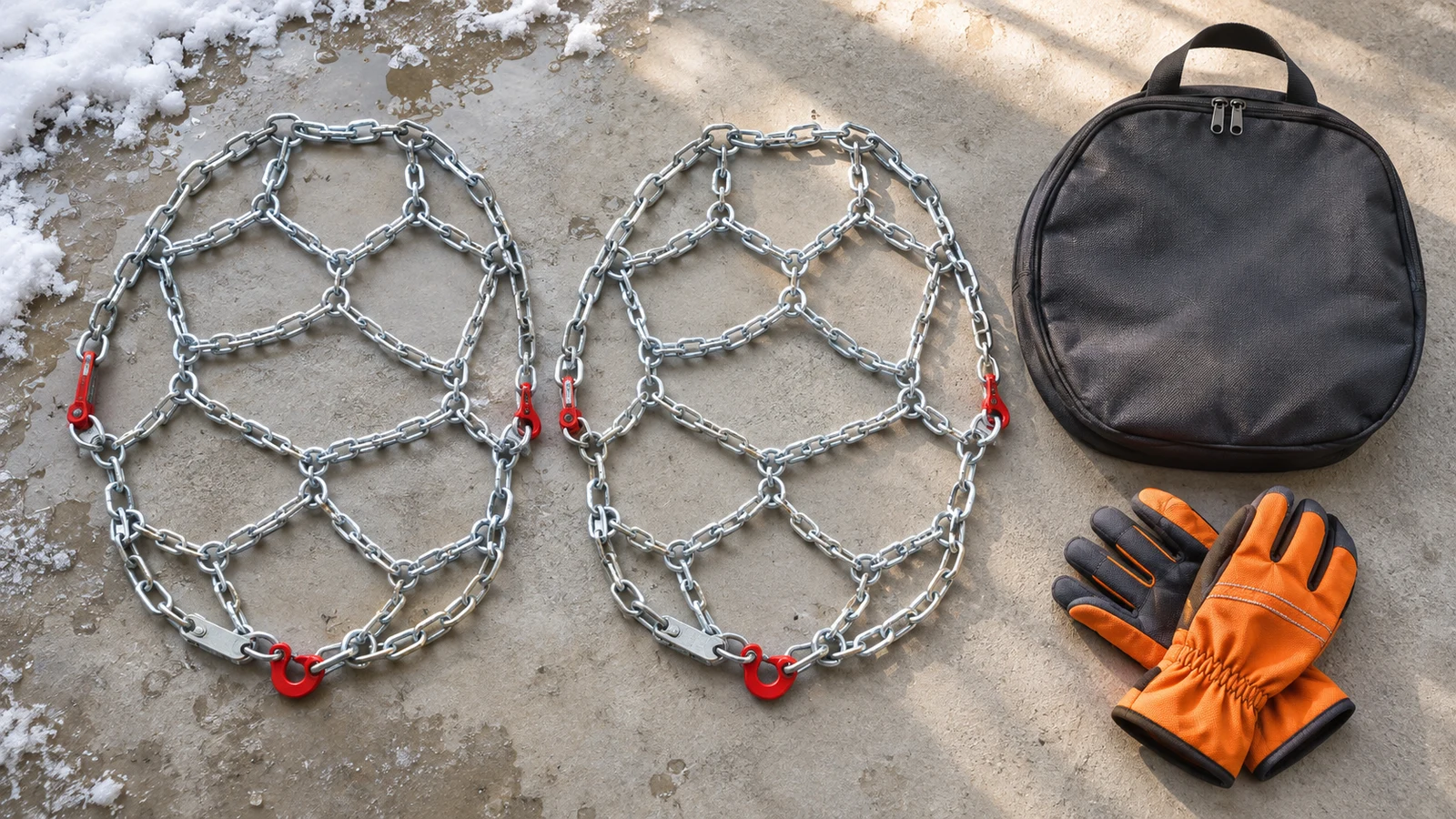
Start with this category when the owner’s manual specifically allows cables or sets a clearance limit that restricts conventional link chains. The important numbers are the requirements published for the exact model, particularly how far hardware projects toward the suspension. The outside fastener is easy to see in a product picture. The hardware on the inner sidewall is just as important when determining fit.
Low-profile construction can help when space is limited, but the front of the package cannot establish what fits your car. Find the tire size and the part number in the manufacturer’s chart. Then read the fit notes, which may distinguish vehicle types or exclude certain tire configurations. The Peerless traction catalogue includes an application guide and product-specific clearance comparisons.
For a concrete starting point, compare Peerless Super Z6 listings only after confirming the manual permits a cable device. The family name is useful for finding the product, while the specific SKU is what you need to compare at checkout. A seller might list the same photo for several variants, so check the model number selected in the cart as well as the headline.
Check Super Z6 sizes on Amazon
When a diamond-pattern link chain makes sense
A diamond layout places angled sections across more of the tread area around the circumference. The pattern can help you understand where the links will sit, but it cannot tell you how the chain will feel in your vehicle. Link size, fit, road surface, tension and the design of the whole assembly all matter. Treat the pattern as one feature to compare after disqualifying anything your manual does not permit.
Check how the inner connector works and whether you can operate the outside tensioning mechanism with gloves. Look for an installation guide for the exact product. A self-tensioning design may reduce manual adjustment compared with a model that uses separate tensioners, but you still need to follow the maker’s instructions about pre-fitting and checking tension. Verify whether the particular model protects wheel surfaces that come near the fastener.
Peerless Auto-Trac is one option to investigate when your manual permits compatible link chains. Compare the product’s fit-chart entry with your actual tire size and vehicle restrictions. If you are choosing between two compatible models, compare the instructions side by side and think about which fasteners you can reach around your wheel with gloves on. The easier kit to operate in your practice area may be the better purchase for your trips.
Compare Auto-Trac sizes on Amazon
When a ladder-pattern link chain makes sense
A ladder design has cross-members spanning the tread between two side assemblies. Start here if your vehicle permits this kind of link chain and your tire size appears in the product chart. Look up the exact link thickness and clearance requirement. Different models can share a similar appearance while using substantially different hardware.
A traditional ladder kit may be appealing if you are comfortable with its fastening method and can confirm the tensioning accessories it calls for. Read the packing list before comparing prices. One kit may include a required part while another expects you to buy it separately. The cheapest box becomes less useful if you cannot get the compatible tensioner or replacement instructions when you need them.
Peerless Quik Grip is a family worth comparing for vehicles that explicitly allow the selected pattern and construction. Locate the application in the manufacturer’s catalogue before looking for a listing. Be careful when a listing groups passenger, SUV and light-truck variants together. This comparison describes fit and purchase criteria from published information and does not rate stopping distance or firsthand performance.
Find compatible Quik Grip listings
Three common buying scenarios
Your crossover has a cable-only restriction
Write down the axle specified in the manual and read the tire code from that axle. Look for a compatible cable model that meets the clearance specification and is accepted for the route you will drive. If you find two compatible cables, compare their installation instructions and availability in the correct size. The decision here is which permitted cable to buy, rather than which design headline sounds most capable.
Your SUV allows compatible link chains
Compare diamond and ladder designs only after finding a matching part number for both. Look at how each kit secures at the back of the tire and how the tensioner is installed. If you rarely drive in regulated winter conditions, prioritize the fit guide you can confidently follow and the kit you can practice with. If the manufacturer lists special restrictions for one wheel package, match the actual wheels and tires before assuming the instructions for another trim apply.
You have an older set from another vehicle
Use the part number stamped on the packaging or identifiable from the manufacturer’s instructions. Look up that exact part in the fit chart for the tires currently mounted on the new vehicle. Check the vehicle manual for construction and clearance limits. Inspect the device for damage, corrosion or missing fasteners and follow the maker’s inspection guidance. If you cannot identify the part or confirm fit, leave it off your shortlist and find a supported replacement.
What matters more than the pattern?
The actual tire code. A seller’s “fits 17-inch wheels” filter leaves out tread width and aspect ratio. Write down the complete marking and verify any prefix the chart distinguishes. The original door placard can help identify the stock size, but the tire currently on the wheel is the relevant size for ordering.
The exact axle. AWD, 4WD and two-wheel-drive vehicles can have different instructions. The owner’s manual provides the installation axle and limitations for your vehicle. If the fit chart and manual appear to conflict, check with the vehicle or chain manufacturer before purchase.
The name on the listing. Open your cart and compare the selected model number with the chart. Look for the number of devices included and any tensioning accessories required. If the package arrives labeled with a different part number, sort that out before the trip. Do a practice fit at a safe, level location as the manufacturer directs, then pack the instructions with the kit.
The road authority’s rules. A device that fits may still be unsuitable for your route. Check what traction devices your road authority accepts and any current restrictions before leaving. If you drive in California, see the Caltrans chain requirements guide and check the current route separately.
A side-by-side check before you buy
Imagine you have three browser tabs open: a cable kit, a diamond-pattern chain kit and a ladder-pattern chain kit. The photos all look right and every listing includes your wheel diameter. Put your owner’s manual on one side of the screen and each manufacturer’s fit chart on the other. Write the approved axle and your full tire code at the top of a note. Below that, record the three exact part numbers, the hardware each box includes and any fit-chart footnote that applies to your vehicle. Cross off any kit that fails either the vehicle instructions or the chain maker’s fit instructions.
For the remaining kits, compare how you would actually use them. Can you tell which side goes inward from the printed instructions? Can you reach the connection point with winter gloves on? Does the manufacturer explain what to check after you initially fit the chain? Read those instructions before ordering, especially if someone else may be driving the car. A cheaper kit may be a sensible pick when both kits fit and the cheaper one has a fastening sequence you can confidently practice. Include any required accessories and the return costs when comparing prices.
Frequently asked questions
Are cables always thinner than link chains?
Individual products differ. Use the published clearance dimensions for the exact part number. In particular, compare inner-sidewall requirements as well as tread-side projection. The vehicle manual may allow a particular kind of device or set a limit that rules out some products marketed as low profile.
Are diamond chains always better than ladder chains?
There is no universal winner across vehicles, tire sizes and conditions. The layouts differ in how they place cross-members around the tread. Fit, permitted construction, and whether you can install and inspect the kit correctly are more useful buying criteria than the shape alone.
Can I buy by vehicle make and model?
Use vehicle information as a starting point, then confirm the owner’s manual restrictions for your model year and trim and match the tires currently on the vehicle. Retailer vehicle filters can hide different wheel packages or aftermarket changes. The specific traction-device part number is what you want to verify before ordering.
How should I choose between two products that both fit?
Compare fastening steps, what comes in the box, availability of instructions and exact-size return terms. Save the fitting guide offline and practice while you have time to identify any issue. For a wider fit-based shortlist, read our best snow chains for cars and SUVs roundup.